
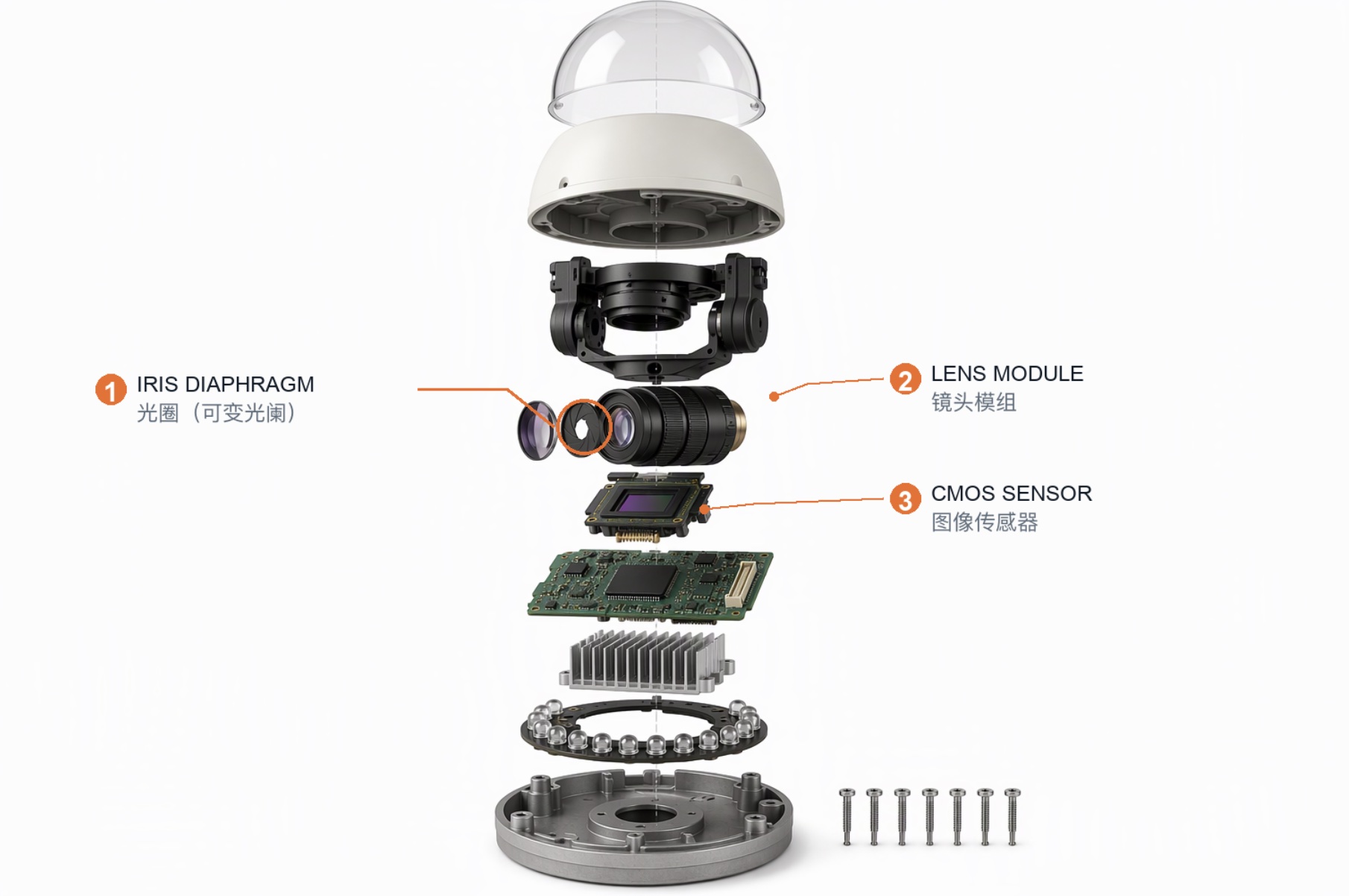
Caption: Exploded view of a 4K PTZ dome. ① The iris diaphragm sits between the lens groups and the image sensor — the only moving optical element that governs exposure and depth of field. ② lens module, ③ CMOS sensor. Note: This is a conceptual exploded view illustrating component hierarchy, not an official teardown of any shipping model.
Open the spec sheets for a few 4K cameras and a pattern shows up that nobody talks about.
The AXIS P1468-LE bullet runs a 6.2–12.9 mm varifocal, f/1.6–2.9, with P-Iris control and IR correction. The AXIS Q3538-SLVE dome, 8 MP and stainless steel, carries the same 6.2–12.9 mm, f/1.6–2.9, and the same P-Iris control. Bosch’s FLEXIDOME 8000i generation, 8 MP, runs a 3.9–10 mm lens at f/1.6–2.7, P-Iris again.
Three brands, three focal lengths, one shared ceiling: no 4K lens stops down past about f/2.7–2.9.
That is not a manufacturing limit. It is a decision.
Stopping down usually helps. At 4K, it stops helping.
Every photographer learns to stop down for sharpness. That works while aberrations dominate the image. Keep closing the aperture and a second effect takes over: diffraction.
Light passing a small opening spreads out. The smaller the opening, the wider the spread. The Airy disk diameter is roughly d ≈ 2.44 λ N, where λ is wavelength and N is the f-number.
At 0.55 μm, that gives about 3.8 μm at f/2.8, 5.4 μm at f/4, and 10.7 μm at f/8.
Now the other side of the comparison. A 4K sensor in 1/1.8″ format spreads 3840 pixels across roughly 7.2 mm. Pixel pitch lands near 1.9 μm.
Put the two numbers together. At f/2.8 the diffraction blur is already twice the pixel pitch. At f/4 it is 2.8×. Beyond that point, a better lens buys nothing, because the limit is no longer optical.
A camera that closes to f/8 in bright sun is not protecting the image. It is deleting the 4K it was sold with.
What P-Iris actually changes
The common description, “P-Iris is a better auto iris”, misses the mechanism.
A DC iris is driven by a brightness feedback loop. The camera knows whether the scene got brighter or darker; it does not know where the blades are. In flat noon light the loop keeps closing until the signal comes back into range, and it has no reason to stop before the mechanical limit.
P-Iris is a stepper with position control. The camera commands a specific f-stop and the mechanism goes there and holds. Exposure is then trimmed with shutter and gain, which are free, instead of with aperture, which costs resolution.
That is the whole trade. You are not buying a fancier motor. You are buying the ability to say “stop at f/2.8” and have it happen.
Domes and bullets want different things
Inside a PTZ dome, space is the constraint. Pan and tilt have to move, the lens has to zoom, and iris, focus and zoom mechanisms all share a housing a little over a hundred millimetres across. Every millimetre of axial length matters, which is why the iris usually sits at the rear of the lens block, tight against the sensor. Coaxial assembly tolerance is unforgiving there.
A bullet has room, but a high-ratio zoom has longer, heavier glass. The blades have more inertia to overcome, which makes holding torque matter. If the iris drifts when power drops, every boot starts with a homing cycle that should not be necessary.
Blade count is the other detail that gets skipped. A six-blade iris makes a visible hexagon; at small apertures the diffraction pattern picks up that geometry and the image stops being uniform. Fourteen blades approximate a circle closely enough that the effect disappears. It is geometry, not marketing.
The four irises we build
| Model | Clear aperture | Blades | Step angle | Typical use |
|---|---|---|---|---|
| KYPI115 | 1.5–32.7 mm | 14 | 1.03°/step(At 2-2 phase) | 4K domes, mid-to-large zoom blocks |
| KYPI176 | 1.03–26.5 mm | 11 | 0.433°/step(At 1-2 phase) | General domes and bullets |
| KYPI213 | 1.05–13 mm | 8 | — | Compact mid-aperture bodies |
| KYPI143 | 0.6–9.76 mm | 6 | 0.736°/step(At 1-2 phase) | Small modules, consumer cameras |
Three things we expect customers to test rather than take on faith: repeatability at a commanded f-stop, consistency across the full travel, and cold-start behaviour. Fail any of them and a P-Iris is just an expensive DC iris.
Where DC still wins
Not every camera needs this. On a 2 MP sensor with 3 μm pixels, closing to f/5.6 produces a 7.5 μm Airy disk, still inside the acceptable band. A DC iris handles that scene for roughly half the cost, and there is no shame in it.
P-Iris earns its price in two situations: 4K and above, or sites with extreme contrast where a specific working aperture has to be held — entrances, toll booths, parking ramps. Those locations share a trait: illumination swings by an order of magnitude during the day, and both near and far objects have to stay readable.
If you have a camera that looks fine in the morning and soft at two in the afternoon, try this before replacing anything. Lock the iris at f/2.8 and shoot the same scene again. The answer is usually right there.
FAQ
Q1. P-Iris or DC-Iris for a 4K dome? P-Iris. On a 1/1.8″ sensor with ~1.9 μm pixels, the Airy disk reaches 5.4 μm at f/4 — nearly three times the pixel pitch — and the image starts to soften. P-Iris holds the aperture near f/2.8 instead of closing down in bright light.
Q2. Will a P-Iris lens work on a camera that only supports DC-Iris? No. The drive signals and motor types differ, and the camera needs matching firmware. The usual symptom is an iris that does not move, sits fully open or closed, or oscillates.
Q3. Why do 4K lenses stop at f/2.7–2.9? Diffraction. At 1.9 μm pixels and f/2.8 the blur circle is already twice the pixel pitch; closing further only softens. The ceiling protects the resolution the sensor was sold with.
Q4. Does blade count matter? Yes. Fewer blades (six, for example) produce a polygonal opening, and at small apertures the diffraction pattern inherits that shape, reducing uniformity. Fourteen blades approximate a circle.
Q5. Do domes and bullets need different irises? Domes are axially constrained and usually place the iris at the rear of the lens block against the sensor, with tight coaxial tolerance. Bullets allow more room but carry heavier zoom glass, so holding torque matters more to prevent drift after power loss.
About KUYANG
Shenzhen KUYANG Electronics has spent thirty years on opto-mechanical components: P-IRIS auto irises, infrared shutters, IR-CUT switching modules, LWIR lenses and micro drive modules. Iris, shutter, filter switching and motor are designed under one roof to a single interface, which is what makes compact integrated mechanisms possible. ODM/OEM and 2D/3D customization supported; small lots accepted.
Contact: kuma@ky-ele.com | +86 755 8465 6532 | WhatsApp +86 133 3297 4323