
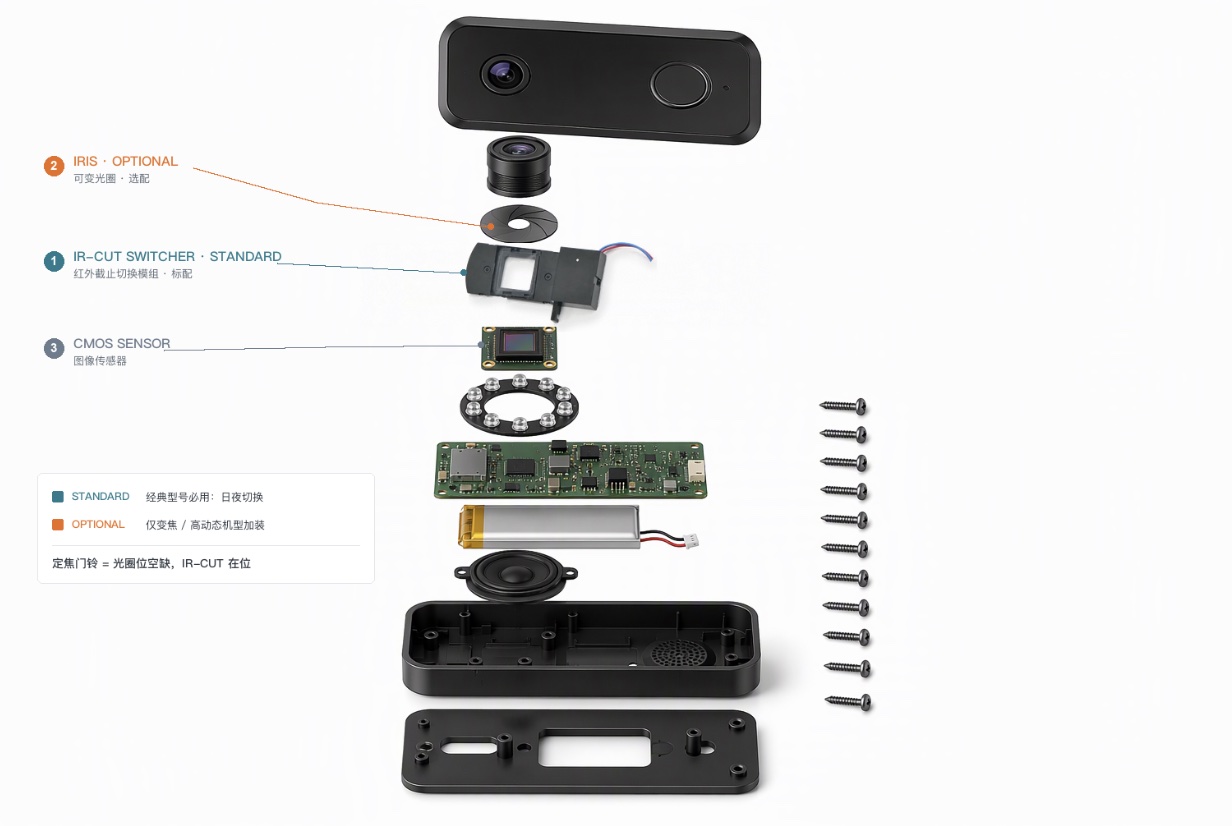
Caption: Exploded view of a video doorbell. ① The iris and IR-cut module sits between the lens and the sensor — fixed-focus doorbells usually keep only the IR-cut half; zoom or high-dynamic-range models carry the full iris. ② CMOS image sensor. Note: This is a conceptual exploded view illustrating component hierarchy, not an official teardown of any shipping model.
Take a video doorbell apart and the optical stack looks unfinished.
There is a lens. Behind it, a square piece of purple-tinted glass. Then the sensor. No blades, no coil, no four-wire harness running back to the board. If you have opened enough of them, the absence is jarring the first time and obvious afterwards.
The spec sheets agree. Reolink lists the lens on its PoE doorbell as f=2.26mm F=2.0, with IR cut. That F2.0 is a single value, not the bottom of a range. What follows it is not an iris specification at all — it is a note that the infrared cut filter is included.
Almost no consumer video doorbell has an adjustable iris. That is not corner-cutting. It is arithmetic.
Why the iris got designed out
Depth of field first. A 2.26 mm lens at f/2.0, focused around 2–3 m, holds everything from roughly a metre to infinity acceptably sharp. A doorbell has one job: a visitor standing between 0.5 and 1.5 m from the button. There is nothing to isolate, no background to blur, no depth-of-field decision to make.
Thickness second. The Reolink unit is 23 mm front to back, and that volume has to hold the button, microphone, speaker, Wi-Fi antenna and battery. An iris mechanism costs three to five millimetres of axial length plus radial clearance for the blades to sweep. On a product this thin, that is not a rounding error.
Power third. Battery doorbells wake on PIR and stay awake for seconds. A mechanical iris draws current whenever it moves. Adding one is a straight cut to runtime.
So the design settles into a clean division of labour: exposure handled by electronic shutter and gain, day/night handled by the IR-cut filter, depth of field handled by fixing the focal length. Four parts, no iris.
Where the arithmetic changes
Two cases where a fixed aperture starts costing more than it saves.
Optical zoom. The moment an indoor PTZ adds 3× or 5× zoom, focal length moves and light throughput moves with it. Holding a constant f-number across the range requires either a compensating floating element or an actual adjustable iris. The longer the ratio, the less optional it becomes.
Extreme doorway contrast. A west-facing front door, a glass lobby entrance, a garage ramp: dynamic range well past 100 dB. A fixed aperture has only shutter and gain to work with, and the result is clipped highlights or noisy shadow. An iris does not make the camera more sophisticated here. It is the only way to hold both ends at once.
There is a middle case worth naming: 4K doorbells. At 1.5 μm pixels under hard noon light, a fixed f/2.0 forces very short exposures, which makes rolling-shutter artefacts and noise more visible. Stopping down one stop is cleaner than pushing shutter speed.
The part that actually moves, every single day
Iris or no iris, one mechanism in a doorbell cycles constantly: the IR-cut filter switcher.
It flips at dawn, flips at dusk, and on some models flips again when a cloud passes or headlights sweep the porch. Call it four cycles a day. Over five years that is north of seven thousand actuations. If it sticks, the image goes pink in daylight or black at night.
And structurally it lives next door to the iris: same gap between lens and sensor, same axial budget, same coaxial alignment requirement. Built as two separate modules, that is two assemblies, two alignment steps and two harnesses.
That is the case for an integrated IRIS + IR-CUT module. One housing carries both, calibrated once before it leaves the line. The camera maker saves an assembly station, a connector and an alignment operation. The product saves thickness, which on a doorbell is usually the harder currency.
What we build
| Model | Clear aperture | Blades | Typical use |
|---|---|---|---|
| KYPI115 | 1.5–32.7 mm | 14 | Larger zoom blocks, 4K bodies |
| KYPI176 | 1.03–26.5 mm | 11 | General domes and indoor PTZ |
| KYPI141 | 1.05–13 mm | 8 | Compact bodies |
| KYPI143 | 0.6–9.76 mm | 6 | Small modules, doorbells, bullets |
IR-cut switchers come in four filter sizes: KYPE276 (7×7 mm), KYPE230 (8×8 mm), KYPE590 (10×10 mm) and KYPE497 (multi-position). Doorbell-class products usually land on 7×7 or 8×8.
Three parameters get measured on every unit before it ships: switching time, position repeatability after switching, and cold-start torque. A doorbell lives outdoors; minus fifteen in winter is normal. If those three fail, the datasheet does not matter.
One honest note
Most video doorbells do not need a mechanical iris. Anybody telling you otherwise is probably trying to sell you one.
But if you are building a doorbell with optical zoom, an indoor PTZ, or a unit facing a west-setting sun with more than 100 dB of scene contrast, the trade flips. Skipping the iris saves cost and spends image quality.
The test takes three numbers: focal length, f-number, pixel pitch. Fixed focal length, fixed f-number, pixels above 2 μm — you are fine without one. If any of the three moves, it is worth doing the calculation.
Send us those three numbers and we will put together a mechanical proposal. No charge, no obligation.
FAQ
Q1. Does a video doorbell have an iris? Almost never. Mainstream doorbells use a fixed aperture, listed in the specs as a single value such as f/2.0 with no drive interface. Exposure is handled by electronic shutter and gain; day/night switching is handled by the IR-cut filter.
Q2. Without an iris, won’t a doorbell overexpose in backlight? It can. A fixed-aperture doorbell facing strong backlight has only shorter exposure and lower gain to work with, which shows up as blown highlights or noisy shadows. That is an inherent cost of the fixed-aperture approach, not a tuning problem.
Q3. Is IR-cut the same thing as an iris? No. IR-cut switches a filter in and out to control infrared transmission; an iris changes the clear aperture. They sit next to each other and do completely different jobs, which is precisely why they can share a housing.
Q4. What does an integrated IRIS + IR-CUT module save? One assembly station, one connector, one coaxial alignment step, and several millimetres of axial length. On an ultra-thin product like a doorbell, the thickness is often worth more than the piece cost.
Q5. How do I know whether my product needs an adjustable iris? Check three things: whether focal length changes, whether the f-number is held constant, and whether pixel pitch is below 2 μm. If any of the three breaks the fixed-aperture assumption, it is worth evaluating an adjustable iris.
About KUYANG
Shenzhen KUYANG Electronics has spent thirty years on opto-mechanical components: P-IRIS auto irises, infrared shutters, IR-CUT switching modules, LWIR lenses and micro drive modules. Iris, filter switching and drive motor are designed under one roof to a single interface, which is what makes compact integrated mechanisms possible. ODM/OEM and 2D/3D customization supported; small lots accepted.
Contact: kuma@ky-ele.com | +86 755 8465 6532 | WhatsApp +86 133 3297 4323