
Understanding NUC (Non-Uniformity Correction) in Infrared Imaging
Infrared imaging devices provide us with a new way to observe the world by capturing thermal information that is invisible to the human eye. However, infrared images are not always perfect. Due to manufacturing variations in sensor arrays, infrared images may exhibit non-uniformity and noise. To improve image quality and measurement accuracy, Non-Uniformity Correction (NUC) technology was developed.
Today, let’s take a closer look at what NUC is and how it enhances infrared image performance.
Why Is NUC Necessary?
When an infrared camera operates under interference, measurement accuracy can be affected. Sources of interference include:
- Environmental changes, such as switching between indoor and outdoor scenes
- Large temperature differences in target objects, such as molten steel or frozen materials
Under such conditions, infrared cameras may generate increased noise, leading to variations in measurement results (related concept: thermal sensitivity / NETD – Noise Equivalent Temperature Difference).
To maintain accuracy, infrared cameras typically perform Non-Uniformity Correction (NUC) — also referred to as uniformity correction — to improve measurement precision.
The Goal of NUC Calibration
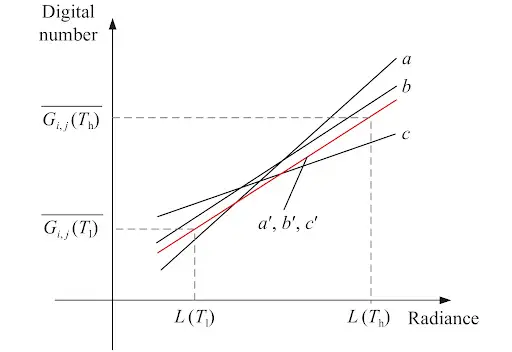
The purpose of NUC calibration is to correct non-uniform pixel responses through algorithmic compensation. Since each pixel in an infrared sensor may respond slightly differently to the same temperature, NUC adjusts pixel sensitivity to ensure that temperature information across the entire image is accurately represented.
In most systems, NUC is automatically executed during device startup. Additionally, periodic manual calibration can be performed to maintain optimal image quality.
Advantages of NUC Calibration
NUC does more than just enhance image clarity. Its benefits include:
- Reducing image noise
- Improving uniformity across the image
- Enhancing visibility of low-contrast targets
- Revealing subtle thermal details
Because of these advantages, NUC plays a critical role in applications such as:
- Scientific research
- Night vision surveillance
- Industrial thermal inspection
- High-precision temperature measurement
As infrared technology continues to evolve, NUC algorithms are becoming more intelligent, enabling broader and more demanding application scenarios.
Working Principle of NUC
After an infrared camera operates for a period of time, it gradually reaches its stable operating temperature. In theory, when measuring a uniformly heated object, the camera should produce an image with uniform temperature distribution.
However, due to factors such as:
- Sensor temperature variations
- Internal component heating
- Ambient environmental temperature
The resulting image may still show non-uniform brightness or noticeable noise. NUC compensates for these inconsistencies, restoring image uniformity and delivering accurate measurement results.
Types of NUC: Internal vs. External Calibration
NUC can generally be divided into two types based on operational methods:
Internal Calibration
This is the most common and convenient approach.
During internal calibration:
- The camera’s internal shutter temporarily closes.
- Compensation values are calculated.
- After a few seconds, the shutter reopens.
- Subsequent measurements are corrected automatically.
Because the shutter closes and reopens, users may hear a “click” sound and see the image briefly freeze. This is normal and does not indicate malfunction.
External Calibration
External calibration follows a similar principle but involves additional steps. The system captures one or more specified reference targets to determine accurate compensation values.
Although external calibration requires more time and effort, it delivers higher measurement accuracy, making it suitable for demanding industrial or scientific applications.
What Is NUC in Technical Terms?
Non-Uniformity Correction (NUC) is a fundamental technology in infrared imaging systems. The core function of an infrared sensor is to convert thermal energy into electrical signals. However, due to manufacturing tolerances, each pixel in the sensor array may exhibit slight performance variations. Some pixels may be more sensitive, while others may be less responsive.
These inconsistencies lead to non-uniform imaging. NUC compensates for these differences through calibration algorithms, ensuring stable, accurate, and high-quality thermal images.
Stay updated with the latest news and product insights from KUYANG Electronic! Follow us on:
Facebook: https://www.facebook.com/profile.php?id=61566592433774
YouTube: https://www.youtube.com/@KUYANG-Electronic